



講座通知:北京大學(xué)未來(lái)農(nóng)業(yè)大講堂第四十七講
2023-07-31 來(lái)源: 作者:
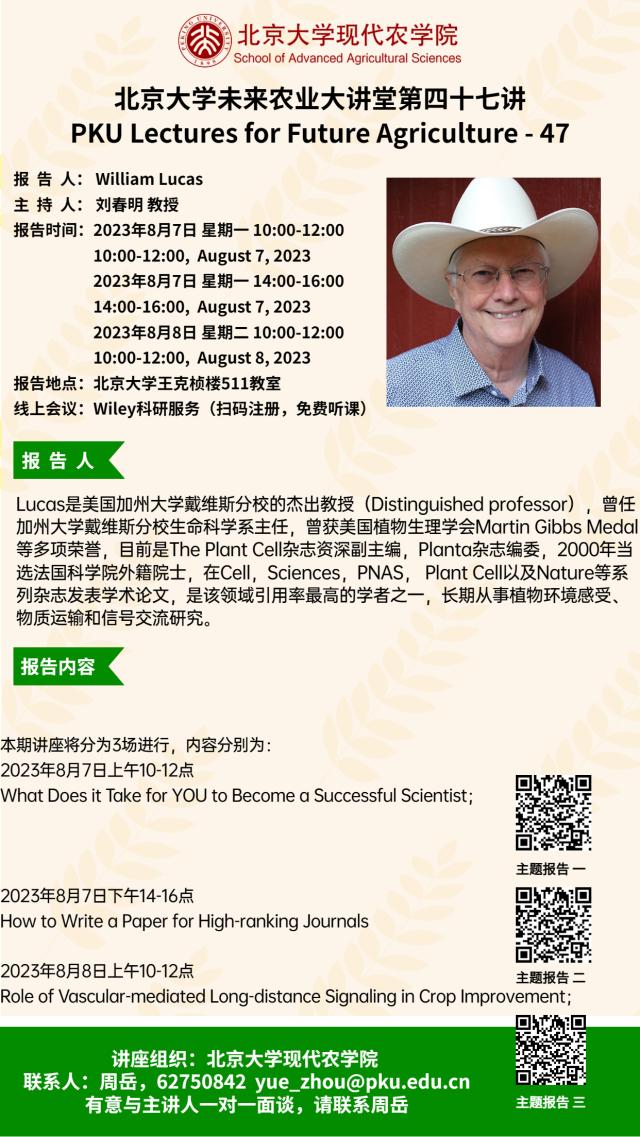
本場(chǎng)講座將分為3場(chǎng)進(jìn)行,內(nèi)容摘要分別為:
主題報(bào)告 一:What Does it Take for YOU to Become a Successful Scientist?
In this seminar will discuss the challenges scientists can experience in developing the skills essential for building a successful scientific career. First, we will discuss the nature and importance of scientific research, in a broad context, followed by an analysis of a set of 6 traits, or characteristics, that young scientists should work towards developing. Examples of these traits will be assessed with respect to pathways leading towards their development by each individual scholar. The importance of these traits, in terms of providing a scientist with the capacity for achieving success, will then be illustrated through an analysis of several successful scientists. This foundation will offer an understanding for the importance of becoming a clear and critical thinker, in addition to developing the skills to be an excellent communicator, both orally and in writing. Finally, the critical role of colleagues, as mentors, will be discussed.
主題報(bào)告 二:How to Write a Paper for High-ranking Journals?
In this seminar, will discuss the challenges scientists experience in developing the skills essential for preparing their manuscripts for submission to the journal of their choice. Here we will discuss the following questions: What is the right journal for your work; When should you select the journal; How do you know when you are ready to begin writing your manuscript; and How do you prepare for writing your manuscript. Next, we will discuss the important/critical steps required for the planning of your manuscript. An important component of this planning is the design of hypotheses-based experiments for testing; here, the importance of controls will be discussed. Top journals demand high quality figures and clear and concise text; we will explore ways for you to develop the writing skills necessary to prepare such manuscripts. Finally, we will discuss the need for discipline and dedication to ensure that your work will be accepted for publication in your journal of choice!
主題報(bào)告 三:Role of Vascular Mediated Long-distance Signaling in Crop Improvement
The plant vascular system contains two transport systems, the xylem and phloem. The xylem serves as the conduit for delivery of water and mineral nutrients from the roots to the above-ground vegetative organs, and the phloem functions in the delivery of photosynthate (sugars), amino acids, and mineral nutrients to both the roots and shoots. Both systems also serve as important conduits for the delivery of signaling agents, including various hormones. Recent studies have established that the phloem also carries various macromolecules, including proteins and RNAs (mRNA and siRNA), which can function in the control of important agricultural traits, including flowering time, plant architecture, nutrient acquisition and use efficiency, and systemic protection against pathogens. In this lecture some established examples will be presented, followed by a discussion of recent findings on the role of the phloem in the early response of cucumber plants to a nutrient (phosphate; Pi) stress condition applied to the root system. These studies provide important insights into the complexity and dynamic nature of this early Pi-stress-signaling system. Finally, we will show that application of this knowledge can be employed to improve plant growth performance, under both sufficient and limiting Pi conditions.